Tuesday, 16 September 2014

SanDisk SD memory card 'largest ever'

SD Card
SD card capacity has increased 1,000-fold in just 10 years

Memory specialist SanDisk has created an SD card with 512 gigabytes (GB) of storage space - the highest capacity ever released.
The card, which is the size of a postage stamp, will go on sale for $800 (£490).
The launch comes a decade after the firm released a 512-megabyte (MB) SD card with one-thousandth of the space.
Experts believe SD cards could eventually hold up to 2 terabytes (TB) of data, about 2,000GB.

The new card is aimed at film-makers shooting in the high-quality 4K format.
The 4K format - which is four times the resolution of HD - requires large file storage. Depending on compression, a single minute of 4K shooting will typically take around 5GB of storage space.
"4K Ultra HD is an example of a technology that is pushing us to develop new storage solutions capable of handling massive file sizes," said Dinesh Bahal, vice-president of product marketing at SanDisk.

The SD card format is one of the most widely used standards of flash storage, popular with digital cameras, camcorders and other mobile devices.
While camera types, resolutions and settings vary - a 512GB card could potentially hold around 30 hours of HD video.

Cloud worries
John Delaney, a senior mobile analyst from IDC, said innovation in physical storage was critical to the future of our devices - even if a lot of people are turning to cloud storage instead.
"The thing that is driving cloud storage is multiple devices usage - which solves the, 'Where's my stuff?' problem: if you use cloud storage for everything, whatever device you have with you can be used to access your content."
But he added: "So far there's still a strong preference for local storage.
"People just feel more in control and more able to rely on being able to access the content when they literally know where it is.

"Storing in the cloud means you literally don't know where it is."
Mr Delaney added that recent high-profile security issues around cloud storage - such as the celebrity picture leak last week - would play on the minds of consumers.
BBC


 

Panasonic launches Lumix camera phone with giant sensor

Panasonic Lumix CM1
The big lens and sensor make the camera one of the thickest smartphones on the market

Panasonic has unveiled a hybrid smartphone-camera, at the Photokina trade show in Cologne.
More camera than phone, the Android device has a Leica lens and a 1in, 20-megapixel sensor more often found in Panasonic's dedicated cameras.
The 2.5cm sensor will help the camera take snaps in low light conditions and shoot ultra-high definition video.
Panasonic said the Lumix DMC - CM1 would go on sale towards the end of 2014 in Germany and France.

The phone is expected to cost about 900 euros (£720) when it goes on sale.
It is widely seen as a rival to Samsung's Galaxy K Zoom, which also has a built-in large lens.
The lens and its metal ring, to control aperture and shutter settings, make the CM1 21mm thick - considerably more than contemporary smartphones.
The CM1 also has 11.9cm touchscreen and a dedicated switch that instantly flips it into camera-mode.

Reviewing the gadget at tech news site Pocket-lint, Mike Lowe said it was an "interesting experiment" that "impressed" him more than he had expected.
However, Marc Flores, at Tech Radar, was more critical, saying hybrids satisfied no-one.

"We've tried this before, and it didn't work out so well," he wrote, adding that anyone looking for a good camera should buy a dedicated device.
Anyone keen to take better pictures with a smartphone, he added, should just learn how the professionals did it rather than buy a CM1 and hope that would make all the difference to their snaps.
BBC


China introduces smartphone lanes to stop pedestrians bumping into each other

A woman looks at her mobile phone as she walks along a Beijing street.

PEDESTRIANS glued to their mobiles are becoming a serious hazard to themselves and others on the street.
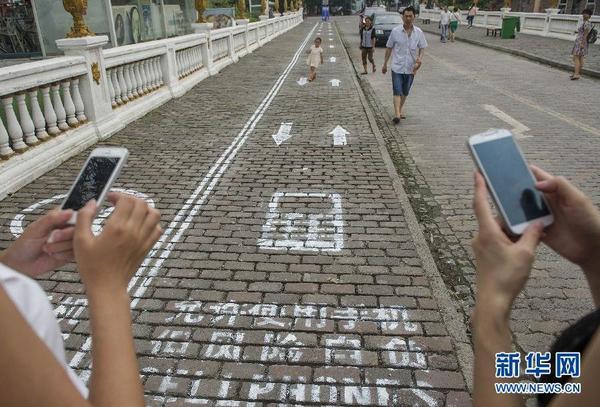
Now China has come up with an ingenious solution — the smartphone lane.
A footpath divided into two lanes for phone users and non-phone users has sprung up in Chongqing city.

View image on Twitter

Unfortunately, mobile phone users were most likely to take out their phones for a photo of the sign, or miss them completely, Yahoo reported.
In 2010, a group called Improv Everywhere chalked up separate sidewalk lanes for New Yorkers and tourists — the latter being more likely to walk more slowly.
Philadelphia introduced an “e-Lane” for electronic device users in 2012 — but as an April Fool’s Day prank.

The press release from Mayor Nutter’s office read: “Stand on any sidewalk in Philadelphia you will see fellow citizens with busy lives who can’t take the time to look up from their iPhones, BlackBerries and other electronic devices. The E-Lane is a safe and convenient option for those distracted walkers.”
So is the special lane a good idea, or just one big joke?

More and more of us are using our phones while walking.
More and more of us are using our phones while walking. Source: AFP
News

US Military's New Laser Gun Zaps Drones


 Boeing's High Energy Laser Mobile Demonstrator (HEL MD).                  
The U.S. military is now one step closer to having a laser gun that can shoot down enemy drones in the blink of an eye.
Boeing recently announced that its mobile laser weapon, dubbed the High Energy Laser Mobile Demonstrator (HEL MD), successfully shot down more than 150 drones, rockets and other mock enemy targets in a third round of tests. The trials prove that the laser weapon is reliable and capable of consistently "acquiring, tracking and engaging a variety of targets in different environments," according to Boeing.

The most recent demonstration of the 10-kilowatt, high-energy laser took place at Eglin Air Force Base in Florida. The laser was installed on a military vehicle, making it the first mobile, high-energy laser built and demonstrated by the U.S. Army, according to Boeing. [7 Technologies That Transformed Warfare]

Directed-energy technologies like the HEL MD could soon be used by the military to augment what are known as kinetic strike weapons, such as missile interceptors, that don't contain explosives but destroy targets by colliding with them at extreme speeds.
Kinetic strike weapons are expensive, and the HEL MD could offer "a significant reduction in cost per engagement," Dave DeYoung, Boeing's directed-energy systems director, said in a statement.

This push for laser weaponryis part of the U.S. military's Ground-Based Air Defense Directed Energy On-the-Move (GBAD) program. The goal of the program is to provide what officials from the Office of Naval Research call an "affordable alternative to traditional firepower," to guard against drones and other enemy threats.
The recent demonstration of Boeing's mobile laser weapon is just a prelude of things to come. By 2016, the military plans to have a 30-kilowatt laser gun ready for testing, according to the Office of Naval Research.

And Boeing isn't the only defense contractor working with the military to develop high-powered laser weapons. In August, the Office of Naval Research awarded Raytheon an $11 million contract to build a vehicle-mounted laser device capable of shooting down low-flying enemy targets. The system will reportedly generate at least 25 kilowatts of energy, which will make it more than twice as powerful as the laser recently tested by Boeing.
Live science


Entangled 'Photon Triplets' Could Speed Up Telecommunication


One of four chips used in the experiment that act as photon detectors. The chips are made of superconducting nanowires.
Physicists have entangled three particles of light faster than ever, creating triplets that stay connected no matter how far apart they are from one another.
In the bizarre world of quantum mechanics, particles can become entangled so that, even if they are long distances from one another, an action on one will affect the others — a phenomenon that Albert Einstein once called "spooky." In the new study, the researchers were able to record data on so many entangled triplets thanks to a new supersensitive photon detector developed at the National Institute of Standards and Technology (NIST).

The new detector allowed the researchers to speed up the experiment, because it could detect photon triplets with a much higher efficiency than older detectors.
The new experiment has implications for quantum computers, which use qubits (quantum particles), rather than 1s and 0s, to store information. Because quantum particles can exist in more than one place at once — a phenomenon called superposition — qubits can store more information than the bits in traditional computers. [How Spooky Quantum Entanglement Works (Infographic)]

Such quantum computers would require multientangled particles, because the more entangled particles they use, the more information they can store and the faster that information can be computed, even compared with such particles being in more than one place at a time. Qubits can exist as either a 1 or a 0 in their superposition state. That means that two entangled qubits could compute four values at once, three qubits could compute eight values at once, and so on. And that's where the new experiment, which generated entangled photon triplets, comes in. (Photons are particles of light.)
"The more entangled photons you have, the more quantum resources you have and the more information you can store," Krister Shalm, a researcher at NIST, told Live Science.

Tangled triplets
Shalm and the team of researchers produced triplet entangled photons in a more stable and more technologically useful state than previous methods did.
The researchers first shot a blue photon through a special crystal that transformed it into two red entangled photons, dubbed "daughter photons," with half the intensity of the first photon. The system then sent one of the daughter photons through a second crystal that created a pair of infrared "granddaughter photons" that became entangled with the daughter photon.

However, quantum entanglement is rare, Shalm said. The two daughter photons only become entangled once out of every billion tries. Once that finally happens, the granddaughter photons from the daughter photon only become entangled with a daughter photon once in a million times. This makes it difficult to study quantum entanglement and apply the phenomenon to things like quantum computing and quantum communication.

The new detector recorded data from the photons 100 times faster than older detectors. The experiment pumped out entangled triplets at a rate of 660 per hour — a big improvement over the seven per hour produced in previous experiments.

Faster communication
The resulting triplet photons generated by the researchers with the new system are right around the wavelengths used in telecommunication, Shalm said. Quantum entanglement is useful in telecommunications, because one photon could be sent to New York, for example, while the other photon is sent to the other side of the world, but the two remain intimately connected and can quickly transfer messages.

However, the experiment's potential application to quantum computing is further off. The setup of the experiment is not scalable, so the huge number of entangled particles needed for quantum computing is still a long ways off, Shalm said. In other words, it's not practical to generate more entangled particles by simply sending each daughter photon through another crystal, where the likelihood of quantum entanglement gets smaller and smaller.
Details of the experiment were published Sept. 14 in the journal Nature Photonics.
Live science


Failing students saved by stress-detecting app


Spot the ones needing help <i>(Image: Todd Bigelow/Aurora)</i>

EARLIER this year, two students at Dartmouth College in New Hampshire who were due to be failed for skipping lectures and not completing assignments were spared the academic axe.
Why the leniency? According to an automated analysis of their smartphone data, both had stress and health-related issues they hadn't told their professors about. So instead of F's and a term's suspension, they were given a chance to complete the coursework over the summer and have now returned to campus.

The students have Andrew Campbell, a computer scientist at Dartmouth, and his colleagues to thank. The students, and 46 others, were enrolled in an experiment to see if data gathered from their phones could be used to guess their state of mind.
Campbell's team set out to discover why, out of a group of students arriving at university with similar qualifications, some excel while others miss lots of classes or even drop out entirely.

The researchers suspected that factors like the amount of sleep students get, their sociability, mood, workload and stress levels all played a role. So they built an app, called StudentLife, that monitors readings from smartphone sensors, and then recruited volunteers to use it over a 10-week term.

The app recorded almost every aspect of life that it was possible to measure, including physical activity levels, frequency and duration of conversations, and GPS location. The camera even watched for when the lights went out each night.

By crunching this data, the app could infer each student's levels of happiness, depression, loneliness and stress. That's possible because "flourishing" students, as the team calls them, are often with other people and have longer conversations, while depressed students interact less with others and have disrupted, or excessive, sleep. Loneliness is marked in part by mainly indoor activity, the team says, and the combination of disturbed sleep and short conversations is a predictor of stress.

The researchers compared these mental states with each student's performance, including grades for assignments and their grade-point average for the term.

"We found for the first time that passive and automatic sensor data, obtained from phones without any action by the user, significantly correlates student depression level, stress and loneliness with academic performance over the term," Campbell says. It also let them see how behaviour like gym usage and sleep times changed when students were faced with assignments or exams.

The results showed that students generally started the term in chipper moods, with most having lots of conversations, healthy sleep levels and busy activity patterns. As the term went on, workload increased, stress shot up – and sleep, chat and physical activity all dropped off. Daily interviews with volunteers confirmed that the automated analyses were accurate. Campbell will present the team's results at UbiComp in Seattle this week.

He believes the results are good evidence that phones will be able to provide continuous mental health assessment – much better than occasional questionnaires filled out when someone feeling depressed visits a doctor. And the app could work for people from all walks of life.

But accessing data on someone's every move will be controversial, even if it saves them their university place or job. "Privacy is the big issue here," says Cecilia Mascolo, who studies mobile sensing at the University of Cambridge. "You need to constrain this to a very specific application that will benefit people, and with the user always in control of their data." Still, she says, with proper protections in place, stress or depression could not only be detected, but also mitigated using information derived from phone sensors.
"People won't be given a prescription," she says. "They will be given an app.
New scientiest


Microsoft acquires Minecraft for $2.5 billion; Notch moves on to greener pastures

Minecraft/Microsoft logo

Microsoft has announced that it will acquire the Minecraft franchise, and its Swedish developer Mojang, for $2.5 billion. Microsoft asserts that it “plans” to continue distributing Minecraft across PC, Xbox, PlayStation, iOS, and Android, but obviously the game’s cross-platform future is called into question by this acquisition. Markus “Notch” Persson, and Mojang’s other two founders, will not be staying with Mojang/Microsoft and will “move on to start new projects.”

Microsoft’s acquisition of Mojang and Minecraft is savvy for two primary reasons. First, Minecraft makes a lot of money (MSFT says the deal will break-even in fiscal year 2015). Second, Minecraft is the most popular online game on the Xbox 360 and Xbox One — and so having Minecraft in-house guarantees continuing support. I’m sure a big part of this was bringing Minecraft to Windows Phone, too — it’s the most popular paid app on both iOS and Android, and it’s one of the major apps that’s still missing from the Windows Phone ecosystem.

The big question now, of course, is how the acquisition will affect Minecraft in the long term. From a purely financial point of view, I seriously doubt Microsoft will withdraw support for iOS, Android, and PlayStation — Minecraft makes a lot of money, and Microsoft will be keen to recoup some of that $2.5 billion.

Minecraft on the Xbox One 

The other option, of course, is that Microsoft will use Minecraft as a carrot, to lead gamers towards Windows, Windows Phone, and Xbox. This could be as simple as discontinuing the other versions of Minecraft — but more there are “nicer” alternatives, though, such as releasing new content and DLC exclusively for Xbox and Windows Phone. Both Microsoft and Mojang make it clear that things should stay mostly the same, but that there’s certainly space for some maneuvering further down the line. With Windows Phone still struggling to make an impression in the smartphone market, and Xbox One lagging behind the PS4, some top-notch game IP could be exactly what the doctor ordered.

As far as Minecraft’s creator, Notch, is concerned, he decided to sell out to Microsoft because the game and the community simply became too big for him to handle. On his blog (mirrored on Pastebin), Notch laments that, “I’m not an entrepreneur. I’m not a CEO. I’m a nerdy computer programmer who likes to have opinions on Twitter.” For a long time now he has been overwhelmed by the massive success of Minecraft — and indeed, he hasn’t been actively developing Minecraft for sometime. Moving forward, Notch says: “I will leave Mojang and go back to doing Ludum Dares and small web experiments. If I ever accidentally make something that seems to gain traction, I’ll probably abandon it immediately.”
EXtreme Tech