Showing posts with label mobile. Show all posts

Wednesday, 3 February 2016

Smartphones Could Generate Own Power with New Coating


A transparent material that can be attached to a smartphone's touch screen could help the device generate electricity whenever anyone taps it, researchers in China say.

Touch screens are now found on most cell phones and tablet computers. Using a touch screen typically involves finger taps, and scientists at Lanzhou University in China reasoned that the mechanical energy from these motions could be converted into electricity to charge the phone's batteries, which could significantly extend the working time of these portable devices.

The researchers developed a new material based on a transparent silicone rubber known as PDMS. Scientists embedded wires in this rubber that were made of lead zirconate titanate that were only 700 nanometers, or billionths of a meter, wide. For perspective, this is about 140 times thinner than the average width of a human hair. [Top 10 Inventions That Changed the World]

As the rubber solidified, the researchers used electrical fields to align the nanowires in the rubber in columns. This alignment helped set both the material's electrical and visual properties.
Whenever such nanowires are bent — for instance, whenever anyone taps on the material — they generate electricity, a phenomenon known as piezoelectricity. By making sure the nanowires are lined up with one another, the researchers helped ensure that they would react to finger taps in unison, generating as much energy from the motions as possible.

When the material is viewed head-on, these incredibly narrow wires are largely invisible, and the material can look mostly transparent. As such, the nanowires "can harvest tapping energy on a screen without influencing the screen's normal working," study senior author Yong Qin, a materials scientist at Lanzhou University, told Live Science.
In addition, when the material is viewed from an angle, the nanowires interfere with light rays, which means that anything seen through the material at that angle will look blurry. As such, the material can also helpprotect a user's privacy by preventing anyone nearby from being able to peek at someone else's smartphone screen.

In experiments, tapping on the material generated an electrical current of 0.8 nanoamperes, or about one-millionth of the electricity used by a hearing aid. The scientists noted that the results of future research could help their material generate more current to efficiently recharge the batteries of mobile devices.
Electrical signals from nanowires could also help researchers develop more sensitive touch screens, Qin said.
The scientists detailed their findings online Jan. 13 in the journal Small.

Monday, 25 January 2016

Verizon Gears Up To Pilot Blazing-Fast 5G Technology In US This Year

Image result for Verizon Gears Up To Pilot Blazing-Fast 5G Technology In US This Year


Verizon boasts that it will be the first mobile data network in the United States to offer 5G technology, and it aims to fulfill the promise in 2020.
As LTE cellular technology is already prevalent, the American carrier sees 5G as the next generation logical step to the interconnected tomorrow. Big names in the tech industry expect to see this technology become an official standard in 2020, so the race is on for mobile operators to have everything needed in place by that time.

For example, NTT DoCoMo wants to provide 5G for its customers before the Summer Olympics in Tokyo makes its debut in 2020, while SK Telecom is more ambitious. The wireless telecom operator says that its 5G network will be operational before the 2018 Winter Olympics in South Korea.

Verizon recently revealed its fourth-quarter financial results, and investors should be satisfied with the evolution.
The consolidated revenue of the company for 2015 clocked in at $131.6 billion, an increase of 3.6 percent when compared to 2014. The breakdown results also show 449,000 postpaid phones and 960,000 tablets during Q4 2015.
At the public results call, the company's Chief Financial Officer Fran Shammo reassured its clients of the carrier's dedication to bringing the 5G into their lives as soon as possible.
Although he was discreet about the details of the new technology, he did mention that tests will take place in two Verizon facilities located in San Francisco and Waltham, Massachusetts.
He also pointed out that the uses and scope of 5G technology goes way beyond the mobile industry as we know it today. One direction that the new network promises to take is the Internet of Things, a field that Verizon dabbles in. As LTE focused mainly on fast connection speeds for mobile devices, 5G has the potential to connect smart home devices that communicate with each other through data packets.
Verizon already tapped into the IoT market and it fares better each quarter.
"New revenue streams from IoT are growing, with revenues of approximately $200 million in fourth-quarter 2015 and about $690 million for the full year. This is a year-over-year increase of 18 percent," the carrier's results show.
Preliminary testing shows that 5G connections can work 40 times as fast as today's 4G LTE networks. Tasks such as downloading a BluRay disc will take seconds. In comparison, an optical fiber link such as the one offered by Google Fiber downloads the file within minutes.
Reports indicate that Verizon's 5G future network should match Google Fiber's 1Gbps internet service.
Verizon appealed to the U.S. Federal Communications Commission (USFCC) to create the legal infrastructure for the upcoming groundbreaking speeds. Last year, the regulator looked into offering higher frequencies for 5G networks in an effort to help carriers offer better broadband coverage to densely populated areas.
For the 5G technology to work as promised, Verizon and its competitors needs the support of the federal regulator.
"For technical trials themselves, we have what we need," Roger Gurnani, chief information and technology architect for Verizon, pointed out.
In order to move beyond the testing phase, Gurnani believes that the 5G needs a "big band of spectrum."
One tricky thing about deploying 5G technology at an accelerated pace is the lack of a universal agreement on what exactly 5G is. In principle, it uses extremely high frequencies for sending data bursts over short distances, but this could mean a huge effort for carriers. They would have to pepper urban areas with thousands of relays in order to give clients a decent, homogenous network.
This is one of the reasons why some see 5G as a complement, rather than a successor to 4G.
Normally, network technology needs a couple of years from the testing lab to the consumer service. Verizon started to test 4G connections in 2008, but the network opened for regular customers as late as 2010.  
To bolster its chances to deliver the promised 5G network until 2020, Verizon teamed up with important OEMs such as Cisco, Ericsson, Alcatel-Lucent, Nokia, as well as mobile technology giants Samsung and Qualcomm. 


Tuesday, 19 January 2016

WhatsApp is free for all users


WhatsApp announced that the popular messaging app would now be subscription-free and promised not to resort to third-party ads.
"We're happy to announce that WhatsApp will no longer charge subscription fees. For many years, we've asked some people to pay a fee for using WhatsApp after their first year. As we've grown, we've found that this approach hasn't worked well. Many WhatsApp users don't have a debit or credit card number and they worried they'd lose access to their friends and family after their first year," WhatsApp announced in a blog post. "So over the next several weeks, we'll remove fees from the different versions of our app and WhatsApp will no longer charge you for our service."

The messaging app used to charge a $1 subscription fee after the first year of free usage. While that might not sound like a lot, every little bit of savings helps.
WhatsApp, along with other messaging apps like WeChat and Viber has become popular as a an easy tool to keep in touch with friends. The startup was bought byFacebook in 2014 for $19 billion, and currently totals 900 million users, CNET reports.
The app assured users that it will not resort to third-party advertising to replace subscription fees.

"Starting this year, we will test tools that allow you to use WhatsApp to communicate with businesses and organizations that you want to hear from," WhatsApp stated. "That could mean communicating with your bank about whether a recent transaction was fraudulent, or with an airline about a delayed flight. We all get these messages elsewhere today - through text messages and phone calls - so we want to test new tools to make this easier to do on WhatsApp, while still giving you an experience without third-party ads and spam."
WhatsApp plans to test these tools later this year, according to CNET.

Monday, 18 January 2016

You can disable the iPhone's default apps


The latest versions of Apple's iOS 9 lets you to delete more than 30 stock apps included on the iPhone

It started with Stocks, then Apple added iBooks, Maps, Watch, Health, Tips and more. There are now 32 apps on the iPhone that users are unable to get rid of.
Many of these are essential, like Settings, Phone and App Store. But others, such as Find Friends and Podcasts, are rarely used by many users.
For years people have been calling for a way to delete some of the phone's default apps. Others squirrel them away in a folder, hoping to ignore them as much as possible.
But now there is finally a way to remove the iPhone's default apps, although it is only available to Apple developers - requiring you to pay £79 - requires a bit of technical confidence and a full reset of the phone. Although it is complicated, it suggests that Apple might finally be ready to allow users to remove default apps.


For users who want an easier way to remove apps, there is a method that allows you to do it without downloading any special software, although the apps return when the phone is turned off and on again. For this method, scroll further down.
Reddit user bfodder revealed how iPhone users who have downloaded the beta version of the new iOS 9.3 software, using a beta version of Apple's Configurator program that lets businesses and schools manage the devices, can get rid of stock apps.

How default apps can be removed

Doing this requires a computer and a bit of technical confidence, so if you're not happy with doing it, you can try the method further down.
  1. Sign up for the iOS beta programme so that you can download the iOS 9.3 public beta - the full release is not out yet. There's a full guide on signing up for the beta programme here, including backing up your device.
  2. Once you've done that, go to Settings -> General -> Software Update to download the iOS 9.3 beta.
  3. Download Apple Configurator 2.2 beta. This requires an Apple developer membership, which costs £79.
  4. Users can then set up a configuration, selecting an option that says "Do not allow some apps". By entering commands for these apps, like "com.apple.stocks" for Stocks, they can be removed from the iPhone. A full list of the commands is her
  5. The easy way to remove apps (temporarily)

    This method, introduced in iOS 9 last year, can remove apps, but they return when the phone is restarted. Here's how it works
    1. Put the apps you want to delete in a folder
    2. Press and hold on those apps so they begin jiggling, as if you were to delete or move an app
    3. Drag that app to the edge of the folder to move so it moves the next page of the folder, but keep the app in place when the page has moved
    4. While still holding the app, press the home button. It should fly off the edge of the screen.
Apple's chief executive Tim Cook said last year that the company was looking at ways of letting users remove default apps, although some apps, such as Phone, are linked to functions in iOS, meaning deleting them could cause problems or render the phone less capable.
Although the latest iOS trick requires a complex work-around, it could be paving the way for the feature to be introduced more widely.

Friday, 15 January 2016

What features to expect in IPHONE 7


We don’t expect to see the iPhone 7 until the fall of 2016. Apple just released their 2015 models, the iPhone 6s and the iPhone 6s Plus.

Apple has used an alternating “S” naming formula to mark years where the iPhone does not have a major redesign since the debut of the iPhone 3GS in 2009. Releases have been as follows:
2007 – iPhone
2008 – iPhone 3G
2009 – iPhone 3GS
2010 – iPhone 4 (new design)
2011 – iPhone 4s
2012 – iPhone 5 (new design)
2013 – iPhone 5s
2014 – iPhone 6 and iPhone 6 Plus (new design)
2015 – iPhone 6s and iPhone 6s Plus
The next-generation of iPhone is expected to be called the iPhone 7. 2015 marked an “S” iPhone upgrade year that introduced new features such as an improved camera and a better processor, but 2016 will bring an even-year upgrade that will likely include an all-new iPhone design.
We are too far away from the iPhone 7 launch to know what the new device will look like, but we can speculate that Apple will continue on its path of introducing more powerful, efficient devices that grow thinner with each design iteration. The iPhone 7 and iPhone 7 Plus are expected to include next-generation A10 processors produced by TSMC.
It’s likely Apple will continue releasing two versions of each iPhone, so we may see an iPhone 7 and an iPhone 7 Plus in 2016. Apple may stick to 4.7- and 5.5-inches, or take the opportunity to further refine screen sizes, shifting the dimensions somewhat to match the company’s design vision for the updated phones.
Though the iPhone 7 isn’t expected to launch until September of 2016, we’re already hearing some rumors about the device. One rumor out of the Asian supply chain has said Apple will switch to glass-on-glass touch panels for the iPhone 7, potentially allowing for an edge-to-edge display, but a second, more reliable rumor from KGI Securities analyst Ming-Chi Kuo, has disagreed with that point, suggesting Apple will stick with in-cell panels.


The continued use of in-cell panels for the iPhone 7 will allow Apple to make the device even thinner, approaching the thinness of the iPod touch at a point between 6.0mm and 6.5mm. Apple’s current iPod touch measures in at 6.1mm, compared to 6.9mm for the iPhone 6 and 7.1mm for the iPhone 6 Plus. Like the iPhone 6s and the iPhone 6s Plus, the iPhone 7 will also use 3D Touch technology.
Apple may also be able to decrease the thickness of the iPhone 7 by up to 1mm by eliminating the headphone jack and instead adopting an all-in-one Lightning connector. According to Japanese siteMac Otakara, Apple will nix the headphone jack and instead introduce a Lightning port that will support both charging and music playback with Lightning-equipped headphones.
Apple may release EarPods with a Lightning connector alongside the new iPhone, and it’s likely the company will produce adapters to allow existing headphones to plug into the device should it decide to eliminate the headphone jack.
Apple is unlikely to adopt AMOLED displays for the foreseeable future, according to Ming-Chi Kuo. This means the iPhone 7 will continue to use existing TFT-LCD display technology.
According to another prediction from KGI Securities analyst Ming-Chi Kuo, the iPhone 7 and the iPhone 7 Plus may have differing amounts of RAM. The smaller 4.7-inch iPhone 7 may ship with 2GB of RAM, while the larger 5.5-inch iPhone 7 may ship with 3GB RAM. Apple has included different features in the two devices in the past, with the iPhone 6s and the iPhone 6s Plus offering different camera technology. The iPhone 6s Plus has Optical Image Stabilization for photo and video while the iPhone 6s does not.
We still have a long wait until the launch of the iPhone 7, but the iPhone 6s and 6s Plus launched in September of 2015. Check out our full roundup on those devices for more information on Apple’s latest iPhones.
The iPhone 6s launched just two months ago, but rumors surrounding its successor are already circulating. Earlier rumors have claimed that the device will feature a waterproof and dustproof design, as well as a new casing material. Now, G For Games reports that Apple is currently in the process of testing five different iPhone 7 models, all with distinct differences.
While the report should be taken with grain of salt, it claims that one model Apple is testing ditching the Lightning connector in favor of a USB-C port. The report also claims Apple is testing various models with wireless charging technology, multi-touch Force Touch, dual cameras, and in-display fingerprint recognition.
Wireless charging has been a feature users have requested often over recent years, but Apple has yet to implement. Our own Ben Lovejoy argued, however, that wireless charging is not on his iPhone 7 wish list due primarily the idea of “charging mats” being too cumbersome. At this point, however, it’s unclear as to how Apple is testing wireless charging.
Presumably multi-touch Force Touch/3D Touch would mean that you could press harder with two fingers to bring up different options than what appears when you press harder with one finger.
In-display fingerprint recognition would presumably allow for Apple to eliminate the home button entirely, something that has been tossed around for a long time now. Apple has been criticized for having too large of top and bottom bezels and removing the home button would allow for the company to finally shrink those.
This report should be taken with a decent amount of skepticism, however. While it’s possible, or even likely, Apple is experimenting with these technologies, it’s hard to say which will actually make it into the final product. Last week, it was reported that the company was looking to ditch the 3.5mm headphone jack, while earlier this month it was reported that the iPhone wouldn’t adopt AMOLED displays around 2018.

Monday, 21 December 2015

Top 10 New Smartphones for Business

This write up contain the list of Ten foremost  new smartphones that is good for business. Business users can be hard to please, particularly when it is about smartphones. Today’s consumers normally want a simple design, complex features, constant internet access, a sofisticated camera and easy-to-use keyboard. We have listed  such smartphones that are very good appropriate for business users.

1. Motorola Atrix 4G 


The Motorola Atrix 4G was awarded the best smartphone at CES 2011. The phone, which is available through AT&T in the United States, operates on Google’s Android 2.2 Froyo operating system,powered by a dual-core 1GHz Nvidia Tegra 2 x 1 GHz processor and 1GB RAM.
The Atrix with its impressive specs,its main differentiator is its ability to connect to a bigger, computer-like docking station, says TG Daily. The handset switches to a “computer mode” when docked and powers the laptop docking peripheral as well as running a desktop operating system interface.

2. Kyocera Echo


Sprint introduced Kyocera’s Echo, a dual-touchscreen smartphone, running on Android 2.2. The Kyocera Echo features includes two 3.5-inch WVGA touchscreens linked together with a hinge. The two screens can be used separately or jointly to operate as a big single screen, according to The Wall Street Journal,the phone also comes with a Simul-Task mode which enable users to simultaneously run two of the Echo’s seven core applications.
According to Wired.com, the Echo runs on Sprint’s 3G network and comes with Wi-Fi hotspot capabilities. The smartphone is also fitted with a 1 GHz Qualcomm Snapdragon processor with 1 GB of RAM and a 5-megapixel camera that is capable of 720p HD video capture. The Echo costs $199.99 with a two-year contract and a $100 mail-in rebate.

3.  HP Pre 3


The HP Pre 3,planned for a summer 2011 launch, runs HP webOS, comes with a 3.58-inch WVGA display, slide-out physical QWERTY keyboard and powered by a 1.4 GHz Qualcomm Snapdragon processor. In addition, the Pre 3 sports business-class e-mail,allows multitasking, video calling and wireless charging capabilities.
The smartphone is the only global webOS device, check the hardware analysis of the Pre 3 on PalmInfocenter. The smartphone supports both GSM HSPA+ and EVDO Rev. The handset also supports Wi-Fi 802.11a/b/g/n, Bluetooth 2.1 EDR and GPS. The Pre 3 also comes with a 1230 mAh battery, 512MB RAM and 8GB/16GB of internal memory, according to Phone Beta
4. Samsung Galaxy S 4G


The Galaxy S 4G, available from T-Mobile,comes with updated HSPA+ technology and features a front-facing camera, Android 2.2 os and behaves like a personal Wi-Fi hotspot. The smartphone,comes pre-loaded with the film "Inception," is also equipped with a 4-inch AMOLED display, 5-megapixel rear-facing camera, 16GB SD memory card and runs on a Samsung 1GHz Cortex A8 Hummingbird processor, according to Digital Trends.

5.  HTC Thunderbolt


The HTC Thunderbolt, available from Verizon,comes with a 4.3-inch WVGA TFT capacitive touchscreen display, runs Android 2.2 os, boasts a 1GHz processor and features front- and rear-facing cameras. The handset also comes with a pre-installed 32GB microSD card and 8GB emmc + 768 RAM Memory card.

 6. Motorola Bionic


The Motorola Bionic, expected to be released in Q2 2011, powered by a dual-core processor, with each running at 1Ghz. The Android handset is available for Verizon’s 4G LTE network. The Bionic has a 4.3-inch qHD display, supports Adobe Flash and HTML5 and comes with an HDMI output. The phone also includes an 8 megapixel camera with HD video capabilities and a front-facing camera.

 7. Google Nexus S


In addition to running Android 2.3 os,Gingerbread platform, the Nexus S is fitted with Near Field Communications, which will enable the device to read smart objects. The GSM Nexus S also comes with a 4-inch Super AMOLED screen, front- and rear-facing cameras, packs a 1GHz Hummingbird processor, 16 GB of internal storage, Bluetooth 2.1+EDR, 802.11n and A-GPS.

8. Samsung Continuum


The Continuum is from Samsung’s Android-based Galaxy S range of mobile devices. The main thing that enables this device to stand out from its list of specs is the Continuum’s independent ticker display, according to Geek.com.
The ticker,which is a secondary screen at the bottom of the handset, shows a running account of news feeds, new e-mail headers, social network updates, time and date. Since the ticker acts on it own from a grip sensor, users may not have to switch on their sleeping phones to retrieve their updates, says Computerworld.

9. BlackBerry Bold 9780


The BlackBerry Bold 9780 comes with the BlackBerry 6 operating system, 512 MB internal memory, and a 2 GB media card. Other features include Wi-Fi, a 5 MP camera, and Bluetooth capability.

10. HTC EVO Shift 4G

The HTC EVO Shift 4G runs Android 2.2 os , is fitted with a 3.6-inch screen, slide-out QWERTY keyboard, 5-megapixel camera with 720 HD video recording, Wi-Fi and the ability to share a WiMAX connection with up to eight WiFi connected devices.

Sunday, 20 December 2015

Fairphone 2 Launched as 'World's First Modular Smartphone'


Fairphone, the company behind the first 'open sourced smartphone'  unveiled back in 2013, is out with its new smartphone known as Fairphone 2. The latest product from the company is acclaimed to be the 'first modular smartphone', something Google has been working on for years now with Project Ara. Google back in August slowed down on the launch of its highly anticipated Project Ara modular smartphones until 2016.

Retailed at EUR 529.38 (approximately Rs. 38,000), the Fairphone 2 will start shipping out December. Olivier Hebert, Chief Technology Officer, Fairphone, said that the company built its second  range smartphone as "a robust phone designed to last as long as possible." The company emphasized on the modular construction for "easy dis/assembly" of the Fairphone 2. The company specifically said that the handset was designed for use and service in Europe only.


"We first looked at the key drivers that make people to replace their devices
on a regular basis and looked critically at the basic features of conventional
smartphone architectures that trigger those drivers. After compiling a range
of improvement features, we selected a subset of items that could be addressed
with clever engineering in a reasonable time frame,and explored the tradeoffs
that were inherent with those various options," added Hebert while
explaining the architecture of the Fairphone 2 in a blog post.
Fairphone also announced that it is collaborating with Jolla to support the
operating system for the Fairphone 2 smartphone. Jolla and Fairphone will
release a customised version of the Sailfish OS for the handset. Till then,
 the Fairphone 2 will ship with Android 5.1 Lollipop out-of-the-box.
For specifications, the Fairphone 2 features a 5-inch full-HD (1080x1920 pixels)
LCD TFT display with Corning Gorilla Glass. It is powered by quad-core
Snapdragon 801 processor clocked at 2.26GHz coupled with 2GB of RAM.
It packs 32GB of inbuilt storage.The dual-SIM based handset supports 2G,
3G, and 4G LTE. The smartphone sports an 8-megapixel rear camera and
a 2-megapixel front camera. The handset was backed by a 2420mAh battery.
It measured 143x73x11mm and weighs148 grams.
It included ambient light, proximity, compass, accelerometer,
and gyroscope.


Tuesday, 16 September 2014

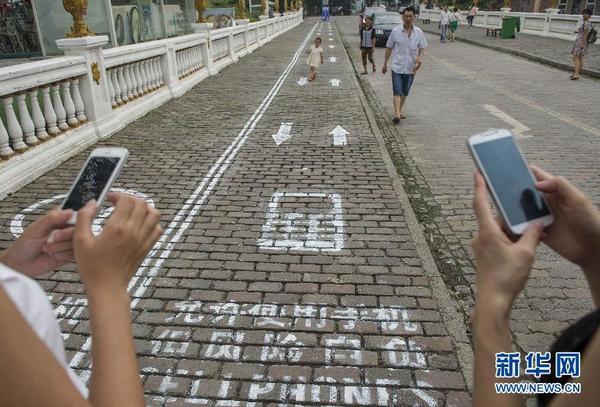
China introduces smartphone lanes to stop pedestrians bumping into each other

A woman looks at her mobile phone as she walks along a Beijing street.

PEDESTRIANS glued to their mobiles are becoming a serious hazard to themselves and others on the street.
Now China has come up with an ingenious solution — the smartphone lane.
A footpath divided into two lanes for phone users and non-phone users has sprung up in Chongqing city.

View image on Twitter

Unfortunately, mobile phone users were most likely to take out their phones for a photo of the sign, or miss them completely, Yahoo reported.
In 2010, a group called Improv Everywhere chalked up separate sidewalk lanes for New Yorkers and tourists — the latter being more likely to walk more slowly.
Philadelphia introduced an “e-Lane” for electronic device users in 2012 — but as an April Fool’s Day prank.

The press release from Mayor Nutter’s office read: “Stand on any sidewalk in Philadelphia you will see fellow citizens with busy lives who can’t take the time to look up from their iPhones, BlackBerries and other electronic devices. The E-Lane is a safe and convenient option for those distracted walkers.”
So is the special lane a good idea, or just one big joke?

More and more of us are using our phones while walking.
More and more of us are using our phones while walking. Source: AFP
News